
Gas & Oil Pipe Installation in Bexley
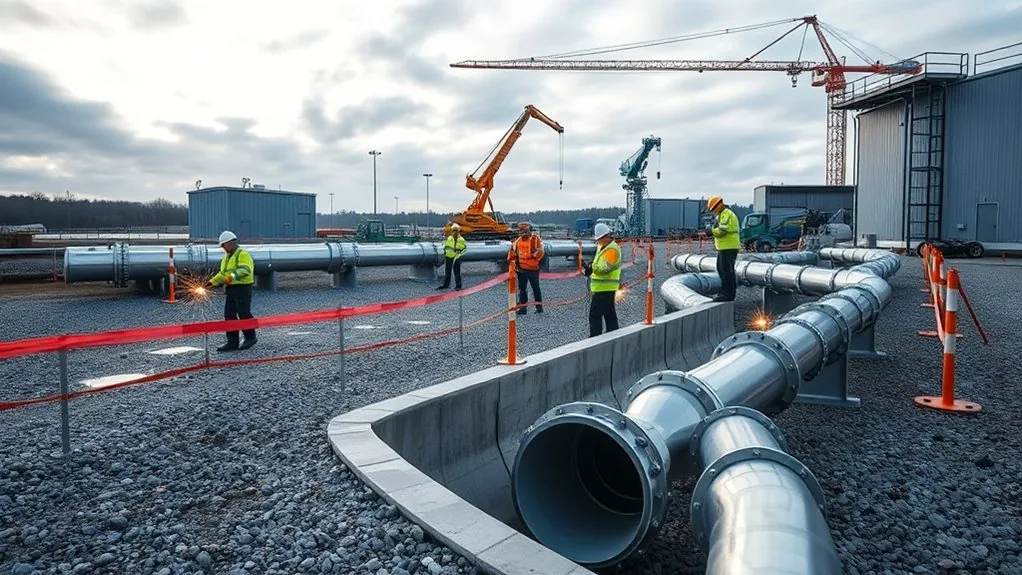
If you need reliable gas and oil pipe ducting and installation in Bexley that meets strict British and European standards, it’s essential to have a system that is correctly sized, carefully routed, and fully pressure-tested.
We provide domestic and commercial pipework solutions using corrosion-resistant materials and modern installation methods to reduce disruption and risk.
Call now for a fast quote or emergency callout in Bexley.
Although the phrase sounds straightforward, gas and oil pipe installation is a controlled engineering process that involves selecting, routing, and securely joining pipework to transport fuel from the supply point to appliances in a safe, compliant manner. You’re not just “running a pipe”; you’re designing a system that maintains correct pressures, flow rates, and isolation points.
You must consider material compatibility, support spacing, thermal expansion, and protection against pipe corrosion, especially in buried or externally exposed lines. Joints are tested using calibrated equipment, and leak detection procedures verify integrity before commissioning. You also need clear identification, accessible shut‑off valves, and compliance with relevant gas and oil standards. Done correctly, installation reduces fire, explosion, and environmental risks throughout the system’s life.
When a new or existing property needs a reliable fuel supply that meets current safety and compliance standards, you’re looking at a situation that calls for professional gas and oil pipe installation. You’ll typically need new or upgraded infrastructure when you’re changing fuel type, increasing load (more appliances or higher demand), or bringing an older system in Bexley up to current Pipeline safety expectations.
You should consider a full installation or replacement if:
When you’re planning gas or oil pipework in Bexley, the process starts with a detailed site assessment to identify load requirements, routing constraints, and existing services. From there, engineers produce a compliant design, install and pressure-test the pipework, and verify performance under operational conditions. Finally, you’ll go through formal safety checks, documentation, and handover so you understand the system layout, isolation points, and maintenance obligations.
Before any trench is dug or a single pipe is laid, a thorough initial site assessment establishes the technical, safety, and regulatory parameters for your gas or oil installation in Bexley. You’ll have existing underground services located and mapped, ground conditions tested, and access routes evaluated to guarantee site safety for personnel and equipment.
Surveyors will measure clearances from buildings, boundaries, and utilities, checking compliance with gas and oil regulations and local authority requirements. Environmental impact is reviewed by identifying sensitive receptors such as watercourses, drains, and habitats, so mitigation measures can be planned early.
You’ll also have temporary works areas, spoil storage zones, and traffic interfaces defined, reducing risks of strikes, contamination, and congestion once construction operations begin.
How does a conceptual route on a drawing board become a safe, compliant gas or oil pipeline in the ground? You start by translating your site assessment into detailed design drawings, confirming loads, pressures, and flow rates. You’ll define pipe sizes, wall thicknesses, and material specifications based on soil conditions, corrosion risks, and operating pressures.
You then map precise horizontal and vertical alignments, avoiding existing utilities, unstable ground, and environmentally sensitive areas. At each stage, you’re checking regulatory compliance with UK gas and oil standards, local authority requirements, and easement constraints.
You’ll also plan isolation points, valve locations, and above‑ground interfaces, building in redundancy and clear access for future maintenance, inspection, and emergency shut‑down procedures.
With the design finalised and all approvals in place, installation turns the specification into a physical, testable pipeline that’s safe to operate. You’ll see trench lines set out, supports fixed, and the correct pipe material verified on delivery against the design schedule and installation regulations.
Sections are then cut, prepped, and joined using approved welding or mechanical methods, with every joint visually inspected and dimensionally checked.
| Phase | Key Activity | Purpose |
|---|---|---|
| Preparation | Verify pipe material, route, clearances | Ensure compliance, avoid clashes |
| Assembly | Cut, align, and join sections | Achieve structural integrity |
| Pressure testing | Hydrostatic or pneumatic testing | Confirm leak-tight performance |
| Documentation | Record parameters and results | Provide traceable QA evidence |
Finally, pressure and functional tests validate performance under operating conditions.
Once installation and testing are complete, the focus shifts to formal safety verification and controlled handover so the pipeline can be brought into service without unacceptable risk. You’ll first confirm equipment safety by checking valves, regulators, supports, and isolation points against design drawings and manufacturer data. Technicians verify pressure ratings, earthing, and corrosion protection, then document serial numbers and calibration records.
Structured inspection procedures follow, covering visual checks for damage, correct labelling, and adequate access/egress. Gas-tightness and functional tests of safety devices, emergency shut-off valves, and monitoring systems are repeated and logged. You’ll receive a handover pack including test certificates, as-built schematics, operating limits, and maintenance requirements. Only when documentation and physical inspections align is the system formally accepted and commissioned.
Although both methods aim to deliver a safe, leak-free network, modern gas and oil pipe installation techniques in Bexley differ markedly from traditional open-cut excavation in terms of ground disturbance, installation speed, and risk profile. With trenchless or semi-trenchless systems, you reduce above-ground disruption, protect existing services, and improve pipeline safety by minimising joint exposure and third-party interference. You also lower Environmental impact through reduced spoil, fewer vehicle movements, and tighter control of drilling fluids and reinstatement.
Traditional excavation gives you continuous visual access to the trench, but it increases manual handling, working-at-height risks at trench edges, and potential trench collapse. It typically generates more waste, dust, and noise, demanding stricter traffic management and more intensive ground support measures.
Because modern gas and oil pipe installation in Bexley uses engineered materials, controlled jointing methods, and rigorously tested pressure systems, you gain a more resilient, longer‑lasting network with reduced leak potential and lifecycle costs. Precision routing and non-invasive techniques minimise disturbance to existing utilities, while calibrated pressure testing verifies integrity before commissioning.
You’re also better positioned to integrate with future renewable energy infrastructure, as compatible ducts and headers can be specified from the outset. Automated monitoring points allow you to track performance, optimise flow, and quickly isolate faults, limiting downtime and safety risk.
Key benefits include:
Whether you’re running a Bexley household or managing a multi-site commercial estate, correctly specified gas and oil pipe ducting underpins safe, efficient operation of your heating and process systems. In domestic properties, you’re typically dealing with shorter runs, lower pressures, and tight plant areas, so you need compact routing, accurate pipe sizing, and robust protection against corrosion and mechanical damage.
In commercial and light-industrial settings, you’re managing higher loads, longer distribution networks, and often multiple boilers, heaters, or production lines. Here, segregation of services, fire-compartment shifts , and access for inspection become critical. Across both sectors, disciplined pipeline maintenance, material traceability, and documented testing are essential to demonstrate regulatory compliance, minimise leak risk, and maintain reliable performance throughout the asset’s life.
From initial route planning to final pressure testing, our gas and oil pipe installation service across Bexley is built around engineered design, strict safety controls, and full regulatory compliance. You get full network surveys, load calculations, and material selection based on operating pressures, temperatures, and media compatibility.
We design routes to minimise Environmental impact, avoid existing services, and maintain mandated separation distances. Trench depths, bedding, and backfill are specified to protect pipe integrity and prevent differential settlement. Above-ground runs are supported to manufacturer tolerances and protected against corrosion and mechanical damage.
During installation, you’ll see documented welding or jointing procedures, leak detection, and phased commissioning. All work is recorded to demonstrate Regulatory compliance with current gas and oil installation standards across Bexley.
In addition to engineered route design and rigorous compliance, you need a contractor whose onsite practices, documentation, and technical standards reduce your operational risk over the long term. You’re trusting us with pressure-rated assets, so we specify materials, jointing methods, and testing regimes that align with the latest British and European standards.
You get full design calculations, weld and joint traceability, and calibrated test equipment records, so you can demonstrate Regulatory compliance at any audit. We model flow, pressure drop, and isolation points to ensure operational resilience and safe maintenance access.
We also assess Environmental impact at design stage, selecting routes, construction methods, and leak detection strategies that minimise disturbance, emissions, and contamination risks, protecting both your site and surrounding receptors.
You’ll naturally want precise answers on installation timeframes, cost efficiency compared with open-cut trenching, and whether your specific location in Bexley is covered. In this section, you’ll see how project duration is calculated based on pipe length, ground conditions, service connections, and required safety checks. We’ll also clarify how trenchless ducting can reduce reinstatement costs and confirm our operational reach across Bexley’s main towns and rural areas.
Although every property is different, most domestic gas or oil pipe installations in Bexley take anywhere from a few hours to two days, depending on pipe length, routing complexity, and any remedial works required. As part of your cost comparison, you’ll need to factor in time for pressure testing, purging, commissioning, and documentation, not just the physical pipe run.
On a typical retrofit, expect survey and design to take 1–2 hours, then 4–12 hours for internal/external routing, clipping, and fire-stopping. Larger or more intrusive works, such as structural penetrations or meter relocations, can extend the programme to two days. Your installer should also explain ongoing maintenance requirements, including visual inspections of exposed runs and periodic checks of supports, joints, and protective coatings.
While it’s tempting to assume that simply running new gas or oil pipework is always cheaper than digging a trench, the true cost difference depends on route length, surface reinstatement, and compliance requirements. A realistic cost comparison must include material specification (steel, MDPE, or barrier pipe), pressure rating, valve sets, cathodic protection, and testing.
You’ll also need to factor in the method of installation. Trenchless techniques (mole boring, directional drilling) often reduce excavation, spoil removal, and surface repair, but require specialist equipment and operatives. Traditional open-cut digging may appear cheaper, yet traffic management, reinstating driveways or highways, and longer programme durations can outweigh savings.
From an environmental impact perspective, less excavation usually means reduced waste, lower fuel usage, and smaller site disturbance, provided safety standards remain uncompromised.
Wondering if your project location falls within our coverage in Bexley? You’re likely covered. We operate across most urban, suburban, and rural zones, evaluating access, ground conditions, and proximity to existing utilities before confirming works. Every site survey factors in local regulations, easements, and safety constraints affecting gas and oil pipe routing.
| Area Type | Typical Locations | Key Considerations |
|---|---|---|
| Urban | Maidstone, Canterbury, Ashford | Congested services, traffic management |
| Suburban | Sittingbourne, Tonbridge, Sevenoaks | Property access, noise and dust control |
| Industrial | Thames-side, Medway, Sheerness | High loads, hazardous-area compliance |
| Rural | Weald, coastal villages, agricultural land | Ground stability, environmental impact |
| New Developments | Housing/industrial estates across Bexley | Future capacity, coordinated utility corridors |
If you’re unsure, share your postcode and site details so we can verify coverage and compliance.
You usually do not need planning permission for new gas or oil pipework in Bexley. The work must comply with Building Regulations and relevant standards, such as Gas Safe for gas or OFTEC for oil. You should ensure proper trench depths, protection from impact, and corrosion control, notify Building Control if required, and use a certified installer to complete testing and documentation.
Existing utilities are located using detailed utility maps, records from asset owners, and on-site detection methods such as CAT & Genny and ground-penetrating radar. Their positions are then confirmed with trial pits before any mechanical excavation begins. To protect utilities, exclusion zones, physical barriers, marker tape, and appropriate backfill are used. All operatives are briefed with utility drawings, permit-to-dig controls are adopted, and depths and offsets are continuously monitored during installation.
Yes, you can upgrade old metal pipes to modern materials without full replacement by selectively replacing sections. You need to assess the durability of existing pipes and plan replacements using approved plastics or coated steels with suitable fittings. It is important to follow safety protocols such as isolation, purging, leak testing, and bonding, while verifying pressure ratings and joint compatibility, and documenting all changes for maintenance.
Your installer should hold Gas Safe registration for gas or OFTEC registration for oil. They need to have appropriate public liability insurance and ideally professional indemnity insurance. Ensure they are qualified for your specific appliance and fuel type, keep CPD records, and can provide commissioning certificates, test results, and documented risk assessments for all installations.
Environmental risks and potential spills during pipe installation are managed through detailed planning, secondary containment measures, and continuous leak detection. Installers verify pipe integrity using pressure testing, calibrated gas detectors, and visual inspections. Spill prevention methods include drip trays, lined excavations, absorbent pads, and designated fuel storage areas. Workers follow method statements, COSHH assessments, and emergency response plans. Spill kits are kept on-site, and trained personnel are prepared to isolate, contain, and report any releases in compliance with regulations.
Once you’ve defined your project scope, the next step is to obtain a precise, itemised quote for your gas or oil pipe installation in Bexley from a qualified, Gas Safe (and, where relevant, OFTEC-registered) contractor. Your quotation should clearly detail pipe materials, diameters, routing, trenching, insulation, pressure testing, isolation valves, and reinstatement, alongside labour, plant, and commissioning costs.
Ask the installer to outline how the design minimises Environmental impact, confirms Regulatory compliance, and integrates with existing plant, meters, and storage tanks. You’ll also want confirmation of design flow rates, diversity assumptions, and allowable pressure drops.
Insist on written method statements, risk assessments, and a programme of works, so you can compare quotations on a like‑for‑like technical basis.